
Richard Madeley faced one of the most chilling experiences of his career when he was almost expelled from El Salvador’s infamous mega prison, Cecot, during the filming of his new Channel 5 documentary, Inside The World’s Mega Prison. Within just fifteen minutes of entering the facility, the Good Morning Britain host found himself being taken aside by prison officials after daring to question the extreme conditions inside one of the world’s most secure jails.
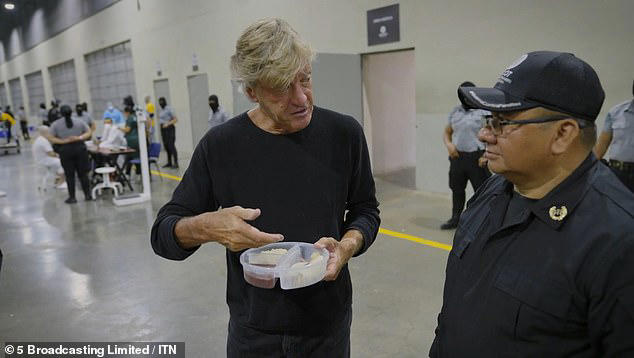
During his visit, Madeley confronted a notorious serial killer known as ‘Psycho,’ a man who admitted to committing 30 homicides and leading a gang since his youth. “You killed 30 people?” Madeley asked, his tone measured yet incredulous. Psycho, unflinching, replied calmly: “Yeah, si.” When asked how it felt to be imprisoned in such a high-security facility after a life of crime, Psycho stated, “This is the end of everything… We’re not getting out because of the crimes we committed. So that’s it. You don’t think much in that life—you have to do what you have to do. You have to kill and you have to control.”
The killer described his mindset in chilling detail. “I’ve always had this concept that once I go into that life I’m going to die in that life. From the moment I watched my rivals shoot my mum and kill my friends, I was going to get revenge.” Despite serving life sentences, Psycho admitted he and his fellow inmates spend their days reminiscing about their criminal pasts. “Maybe we cry at night because we regret our decisions, but in truth, there is no change in us,” he confessed.
Cecot’s environment is designed to be as restrictive and punishing as possible. Inmates spend 23.5 hours per day confined to their cells, which contain no mattresses beyond thin cotton sheets, no books, magazines, or screens, and no contact with family members. Meals are repetitive—typically rice, beans, and tortillas—and must be eaten with hands as cutlery is not provided. Prisoners are allowed just thirty minutes outside daily under heavy guard for exercise or Bible reading and calisthenics. The jail operates on strict protocols, including “forced interventions” where guards enter modules with machine guns, requiring inmates to crouch in perfect formation, legs tightly wrapped around the person in front of them, a brutal human jigsaw puzzle.
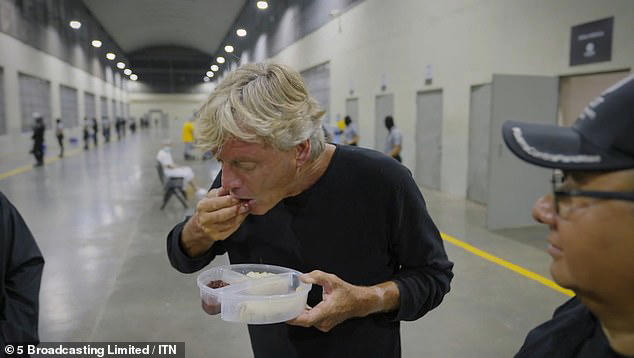
During the filming, Madeley observed the routine distribution of meals, noting that prisoners had no access to green vegetables, and that the diet remained largely unchanged day to day. He even sampled the beans with his hands, complying with prison rules, and remarked on the lack of nutritional balance. “It’s beans and rice every night. Different at lunch with rice and pasta,” said the director. Madeley noted: “They just sit on their bunks, day in, day out, and the prison lights stay on 24/7, never dimmed. All will die in this prison. It’s a living death.”
The facility, sprawling across 57 acres, was constructed to accommodate up to 40,000 inmates, roughly half the total prison population of the UK, and currently holds around 15,000 men. Most inmates are suspected gang members, whose criminal activities have terrorized the country for decades, alongside convicted murderers and rapists. Cecot was opened following a massive crackdown initiated by President Nayib Bukele’s government, with authorities claiming that the initiative has reduced homicide rates by over 50 percent since its inception.
In addition to witnessing the extreme routines, Madeley observed the psychological toll of incarceration. The prisoners’ existence is highly regimented and dehumanizing, designed to break gang hierarchies and impose control. He remarked that the experience revealed stark lessons for the British prison system, highlighting the potential for rigorous discipline and consistency to achieve tangible results in reducing crime and maintaining order. “Once you’ve agreed on the level of security and punishment you want from it, you can achieve consistent results,” he said.

Madeley’s time in Cecot was harrowing but illuminating, offering viewers unprecedented insight into the life of inmates under one of the strictest regimes in the world. From witnessing the meticulous delivery of meals, the regimented exercise sessions, and the stark isolation in the cells, to confronting notorious criminals like Psycho, the documentary painted a picture of extreme incarceration designed for deterrence, control, and punishment.

Ultimately, Inside The World’s Mega Prison showcases not only the terrifying conditions inside El Salvador’s most notorious prison but also the stark realities of gang life, extreme punishment, and the limits of journalistic freedom in highly secure facilities. Madeley’s reporting provides a rare and sobering perspective on incarceration at its most uncompromising.
Source: Daily Mail


